Scheduling has changed. Call our energy-efficient AI Scheduling Agent at (360) 800-4066. Staff line (360) 553-1350 for QEEG or special situations.

Learn

About neurofeedback

EEG neurofeedback is a form of biofeedback. Sensors on the scalp read brain electrical activity and return sound or visuals in real time so a person can practice self-regulation. Educational overview — not a promise of individual results.

Overview

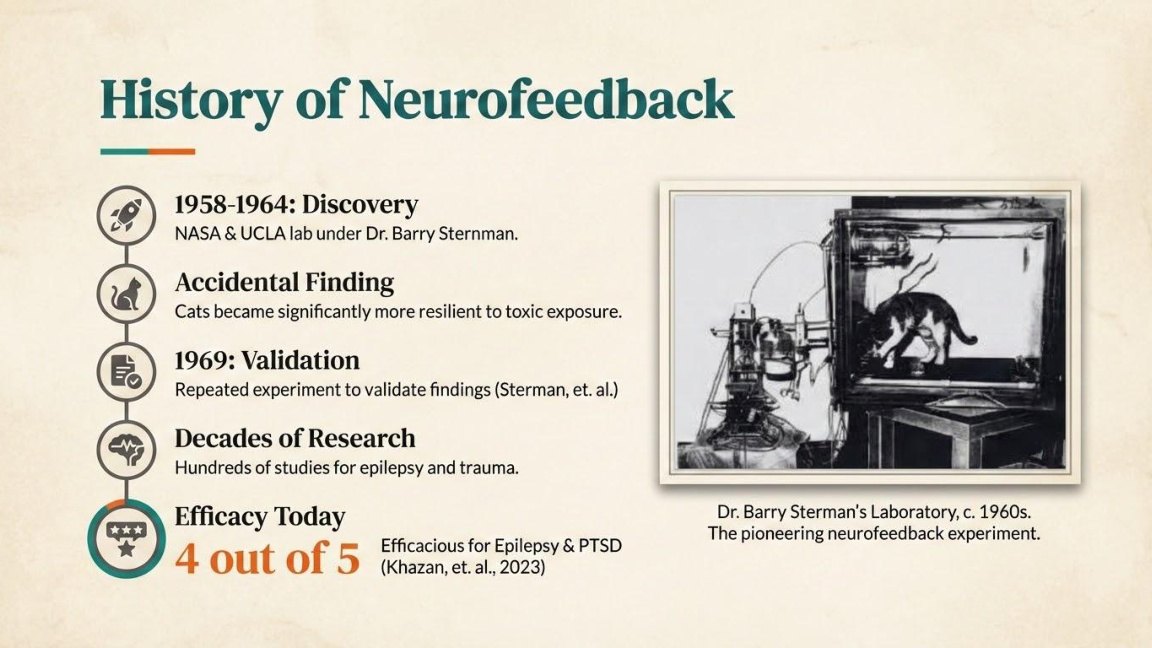
History of neurofeedback from Sterman’s 1960s lab work to current efficacy ratings

History — Sterman lab, 1960s, through current efficacy ratings (1 of 6)

  • EEG neurofeedback is a form of biofeedback: sensors on the scalp read brain electrical activity and return sound or visuals in real time so a person can practice self-regulation.
  • The method grew from M. Barry Sterman’s 1960s UCLA / NASA work and a 1969 validation study. It is operant conditioning applied to EEG.
  • A typical session is about 30–45 minutes. Sensors are placed after an assessment. A practitioner watches the live signal and adjusts thresholds. Many sessions are used, not one.
  • The lecture deck lists ILF, alpha-theta / alpha-down, and SMR as common PTSD protocols. Choice of protocol is a clinical decision, not a website claim.
  • The same deck treats neurofeedback as adjunctive to psychotherapy, not a standalone cure, and notes the time and training required.

Applications

What the evidence says

AAPB field ratings from the 4th edition handbook. Protocol names are from the literature — not a prescription. Graphics for ADHD, epilepsy, depression, and anxiety can be added as lecture slides are ready.

Trauma / PTSD

4 / 5 · Efficacious

Khazan et al. (eds), 2023 — AAPB, 4th ed.

Field rating of published biofeedback and neurofeedback evidence. Not a promise of individual results.

Common protocols

Names used in the literature. Not a protocol prescription.

  • Alpha-theta and alpha-down. Most cited EEG approaches in recent PTSD meta-analyses.
  • Infra-low frequency (ILF). Very slow rhythms; used to settle arousal.
  • SMR (sensorimotor rhythm). 12–15 Hz training for physical calm and focus.
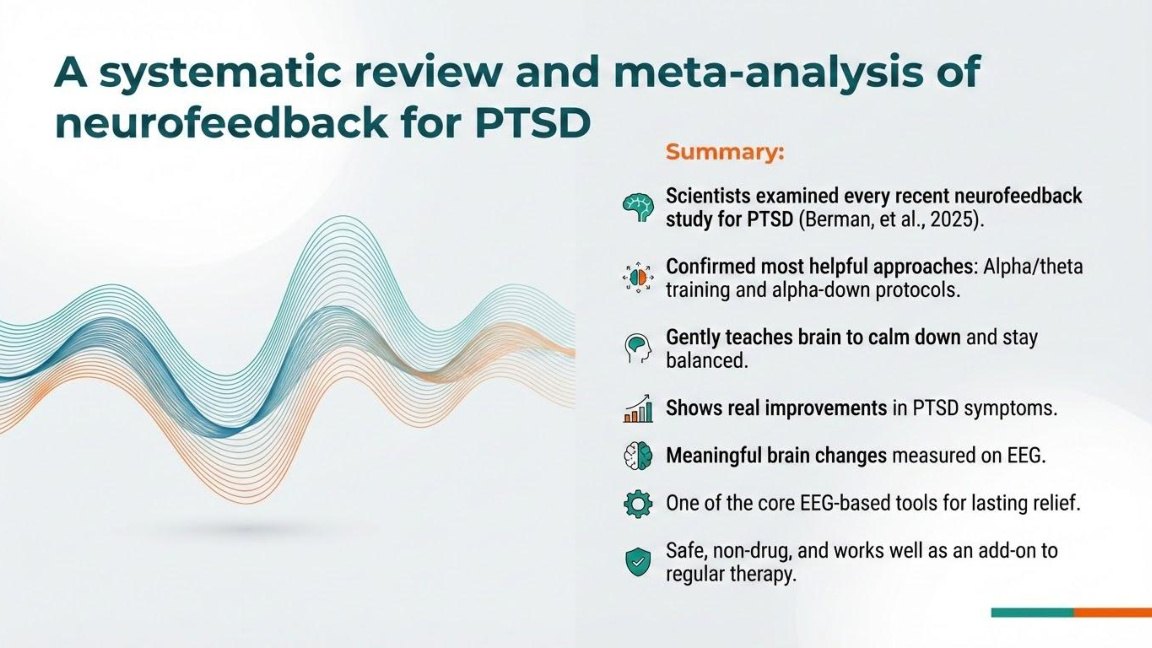
Slide summarizing Berman et al. 2025 meta-analysis of neurofeedback for PTSD

Berman et al., 2025 — systematic review and meta-analysis (1 of 5)

  • Meta-analysis. Askovic et al., 2023 — Ten clinical trials; seven RCTs in the pool. Authors report moderate benefit for PTSD symptoms. Pooled effect was large (SMD −1.76) with very low certainty.
  • Meta-analysis. Berman et al., 2025 — EEG neurofeedback: moderate-to-large vs passive controls (SMD −1.32); smaller and uncertain vs active controls (SMD −0.43, CI crossed zero).

ADHD

5 / 5 · Efficacious and specific

Khazan et al. (eds), 2023 — AAPB, 4th ed.

Common protocols

Names used in the literature. Not a protocol prescription.

  • Theta/beta ratio (TBR). Down-train theta, up-train beta. Lubar line; one of three standard ADHD protocols.
  • SMR. Reward 12–15 Hz over the sensorimotor strip.
  • Slow cortical potentials (SCP). Train slow EEG shifts; common in European ADHD trials.

Graphics coming soon

Epilepsy

4 / 5 · Efficacious

Khazan et al. (eds), 2023 — AAPB, 4th ed.

Common protocols

Names used in the literature. Not a protocol prescription.

  • SMR at the motor strip. Sterman’s original clinical protocol. Sites near C3, C4, or Cz.
  • Slow cortical potentials. Used in some seizure-reduction trials alongside SMR.

Graphics coming soon

Depression

5 / 5 · Efficacious and specific

Khazan et al. (eds), 2023 — AAPB, 4th ed.

Common protocols

Names used in the literature. Not a protocol prescription.

  • Frontal alpha asymmetry (ALAY). Balance left/right alpha at F3 and F4. Best-known EEG protocol for mood.
  • Left-frontal beta up / alpha down. Alternate amplitude protocol used in some depression trials.
  • HRV biofeedback. Peripheral biofeedback often paired with EEG work.

Graphics coming soon

Anxiety

4 / 5 · Efficacious

Khazan et al. (eds), 2023 — AAPB, 4th ed.

Common protocols

Names used in the literature. Not a protocol prescription.

  • Alpha enhancement. Eyes-closed alpha reward for lower arousal.
  • SMR and alpha-theta. Calm-focus SMR, or eyes-closed alpha-theta for deeper settling.
  • HRV, EMG, and temperature. Peripheral biofeedback used alone or with EEG.

Graphics coming soon

More applications

Graphics coming soon

Ready to talk about training here?

Call the AI Scheduling Agent for a consult. Protocol choice is a clinical decision after assessment — including QEEG when appropriate.

Ready to take the next step?

Call or text our AI Scheduling Agent at (360) 800-4066. Appointments are first come, first served. Use the staff line for QEEG, scheduling obstacles, or non-scheduling concerns.

Learn how Front Desk works